

Again, Hard, Good or Easy: How to Rate a Card
What each of the four buttons actually does to a card's schedule, a two-question rule for picking one, and the tricky cases (lucky guesses, half answers, slow recalls).
Every review in Sona ends with the same four buttons: Again, Hard, Good, Easy. They're the only thing FSRS ever hears from you. It doesn't see how long you stared at the card or what you muttered under your breath, only which button you pressed. Studying with Spaced Repetition covers why rating honestly matters. This post is about the moment itself: you've flipped the card, and you're not sure which one to press.
Two questions, in order
1. Did I actually recall the answer before I flipped? If not, it's Again. Full stop, no matter how close you were, how obvious it looks now, or how sure you are you'll know it next time.
2. If I did, how much work was it?
- Hard: you got there, but it took real effort, or you hesitated and weren't confident until you saw the back.
- Good: you recalled it at a normal pace. This is the default; most correct answers should land here.
- Easy: it was instant and effortless, and you'd be fine not seeing this card for a lot longer than usual.
That's the whole rule. Everything below is detail.
What each button actually does
You don't have to guess: the small label under each button is the exact interval that rating would schedule, computed by the same FSRS code that runs when you press it. On a brand-new card, the row looks like this:
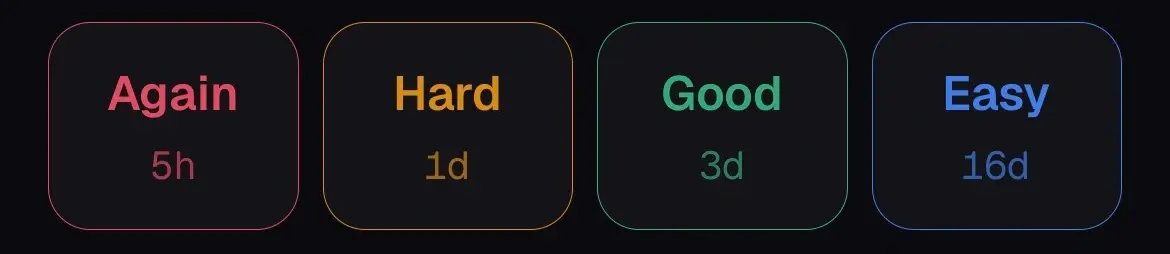
The gaps get much wider once a card has some history. Here's the same row for a card you last saw 20 days ago and are reviewing right on time:
| Rating | Next review in | What happens to the card |
|---|---|---|
| Again | 3 days | Counted as forgotten. Stability drops sharply and difficulty goes up |
| Hard | 28 days | Counted as remembered. The interval still grows, just less, and difficulty goes up a little |
| Good | 2 months | Counted as remembered. The normal step forward |
| Easy | 6 months | Counted as remembered. A big jump, and the card gets "easier" |
Two things stand out. Again is the only button that shrinks the interval, from 20 days back down to 3. And Hard still moves the card forward: 28 days is longer than the 20 you just waited.
Hard is a pass, not a half-fail
This is the most common misunderstanding, especially if you come from a school grading mindset where "hard" sounds like "almost wrong". In FSRS, Hard means you remembered it, with effort. The card stays in review, its interval grows, and Sona's retention stats count it as a success.
So pressing Hard on a card you actually missed doesn't give you a gentler version of Again. It tells the scheduler you knew it, and pushes the next review further out than it should be. It also hides the card from Frequently missed on your dashboard and deck page, which only counts Again. If you didn't get it, press Again.
The tricky cases
You guessed and happened to be right. Again. A lucky guess isn't recall, and the next guess might not be lucky.
You remembered half of it. If the card asks for two things and you got one, that's Again, and a sign the card should be two cards. Good and Bad Flashcards has examples of splitting them.
The back looked familiar the moment you saw it. "Oh, right, of course" is recognition, not recall. Again.
You knew it, but phrased it differently. Good. You're grading whether you remembered the idea, not whether you matched the wording.
You got it, but only after a long pause. Hard. Slow-but-correct is exactly what Hard is for.
It's a brand-new card and you already know it. Easy. On a first review, Easy schedules about two weeks out instead of three days, so cards you already know get out of the way quickly.
You're not sure between Good and Easy. Good. Easy should feel obviously too easy; if you have to think about it, it wasn't.
Habits that quietly hurt
- Pressing Easy to keep future queues small. It feels efficient and costs you later: the card comes back months away, after you've forgotten it, and you relearn it from scratch.
- Avoiding Again because it feels like failing. Again is information, not a penalty. A card you miss comes back after a short gap (a few hours for a new card, a few days for an older one), which is exactly when another look helps most.
- Rating by how important the card is. An important card you know well is still Good. FSRS schedules by memory, not by priority; if something matters for an exam next week, a Quiz is the way to drill it without touching the schedule.
- Rating the topic instead of the card. A hard subject can still have cards you know cold. Rate this card, this time.
Faster rating on the web
On the web, Space or Enter flips the card and 1, 2, 3, 4 press Again, Hard, Good and Easy. Once you trust the two questions above, most reviews take a couple of seconds.